How to Talk To Busy People
When you need answers now, without stepping on toes.
When you are talking to someone who is busy, or important, the added pressure can bring out all kinds of low status behaviours meant to appease this benevolent executive.
However, reverence is not what any GOOD executive is seeking - they want competent people working beneath them whom they can trust. If we show up acting like we don’t believe in our own capabilities, then the executive can’t trust us either. Now they hesitate to delegate to us and we’ve actually made their job much harder.
“Reverence is not what any GOOD executive is seeking - they want competent people working beneath them whom they can trust.”
So ask yourself, do I need to send this message at all? If yes, am I asking for PERMISSION, or just notifying? If it’s the latter, phrase it that way.
Do not accidentally ask for permission when you only needed to inform, because now:
a) you’ve lowered your status for no reason and,
b) you’re now stuck waiting for this busy person to get back to you before you can move on. That’s annoying.
If you’re asking this person to take action, indicate that in the subject line.
Be CONCISE! I challenge myself to see how short I can make an email. What is the bare minimum information they need and what is relevant to THEM (not to me). If they have follow up questions, they’ll ask.
If you do need them to act on something, put forward a suggestion. This makes it the path of least resistance to accept your suggestion. They might or they might not, but you’ve given it the best chance!
Talking to a Busy Person
Is this message completely necessary?
Am I asking or informing?
Is action required? Subject line.
BE CONCISE! Use bullet points when possible.
Don’t justify or overexplain.
Make a recommendation.
Make it easy.
Here is an example of an email I might send to a CEO:
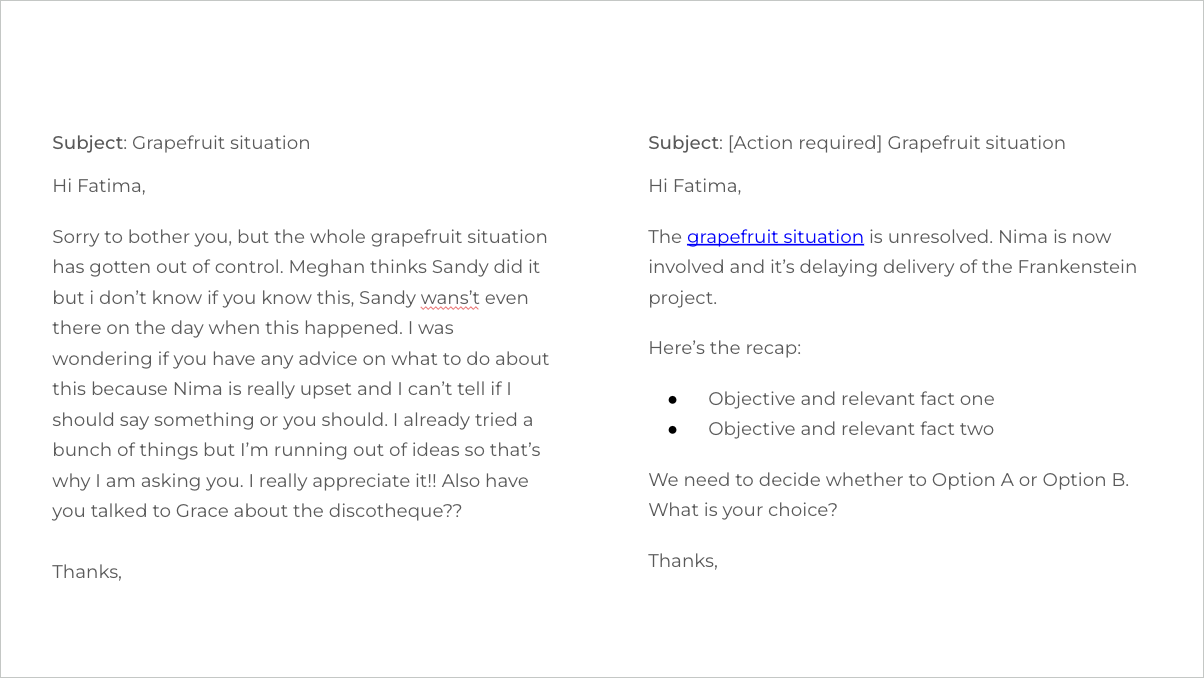
I’ve included a link so if they do want more information they can refer to another document. I want to keep them in my email and not lose them to distraction when they navigate away to figure out what I’m talking about.
I’ve given a brief recap. I’ve presented two options. I’ve indicated WHAT I NEED THEM TO DO: Make a choice.
Do they want a different choice? Maybe. I have NOT said “or whatever you think is best” because it’s wishy washy. They are the CEO, they know they don’t HAVE to choose from my option - they can do anything they want. But I’ve given my options the best chance of success by making picking one of them the easiest path forward.
Looking for support building confidence? Reach out! Book a free intro session here.