How to be Confident III
Last section we confronted failure, and now, even worse, we’re going to talk about your behaviour.
In order to understand how your behaviour and confidence are linked, we have to talk about status.
I am a big fan of improv comedy podcasts. I am a niche nerd. And status, as a concept, first came to me via improv comedy - basically, you have to know your character’s status, and how they relate status-wise to other characters in the scene.
For instance: if one character is playing a queen, then that character has the highest status, and a character playing a a peasant or court jester isn’t going to boss her around or interrupt her.

Look at that pointy hat!
Now, power is real and different people have different types of power in different situations. Someone can have positional power: they are your manager or they are hierarchically above you at this organization. Someone could be an expert, and have information that you want from them.
And if they have this kind of power over you, then it is strategic, probably, to be deferential to those people.
The Seven Types of Power
Coercive: Can punish those who don’t do as they ask.
Connection: Connected to powerful people in the organization.
Expert: Have expertise in a particular area or subject.
Information: Have information that others need or see of value.
Positional: Hold a managerial position.
Referent: Personally liked or respected by others.
Reward: Can reward those who do as they ask.
Where we go wrong, is when we are always deferential to everyone, by default. Or when we let people who don’t have actual power over us treat us as if they do.
And when we always display these deferential behaviours - when we act like we believe we are below others - it can become real.
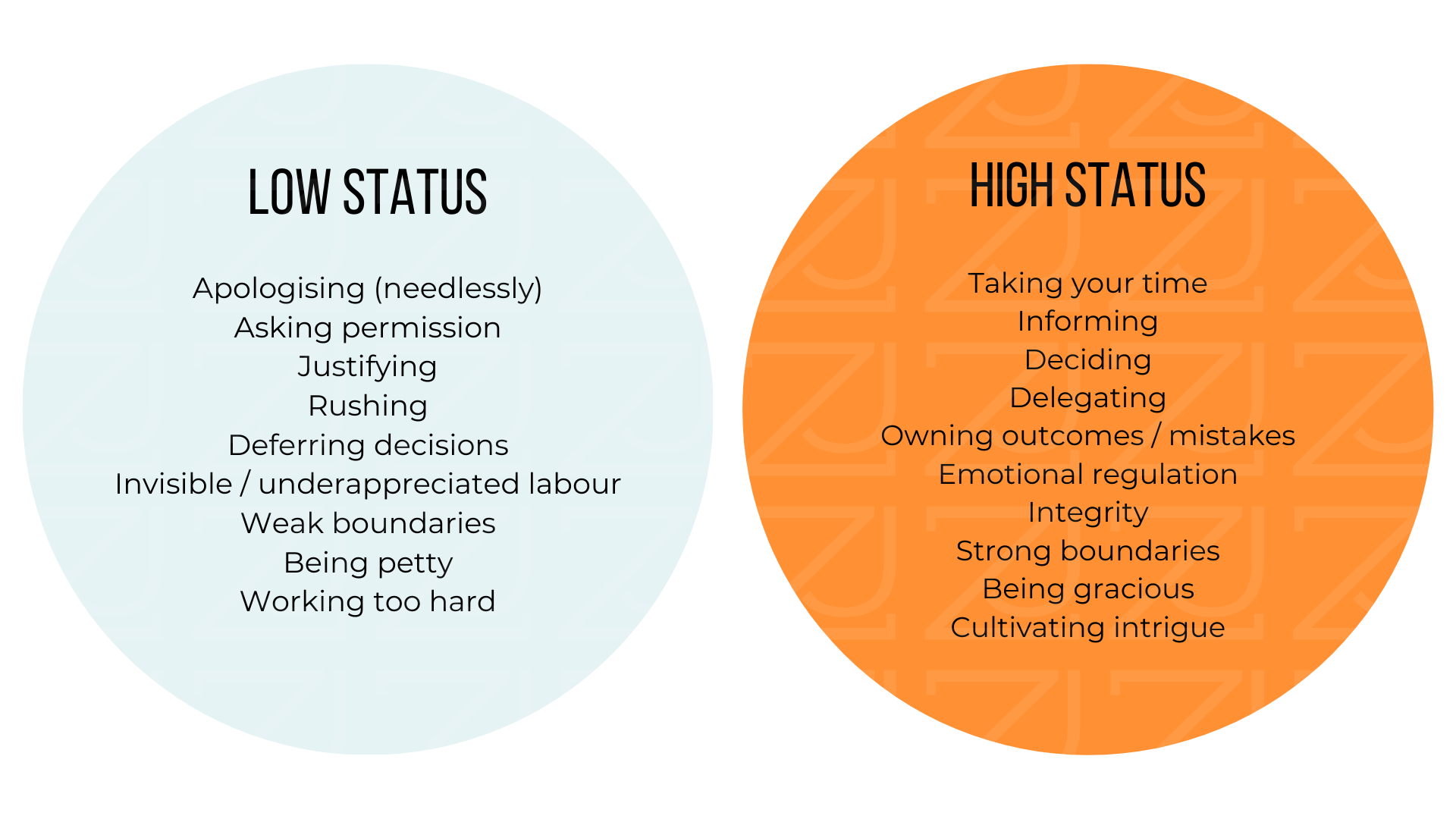
So what kinds of behaviours am I talking about? This is a non-exhaustive list.
Riffed these off the top of my head once and now it’s my most requested work. Who would have guessed!
LOW STATUS BEHAVIOURS
Needless apologizing
Asking permission
Justifying yourself
Rushing or hurrying - Whether it’s when you speak, or to meet a last minute deadline
Deferring decisions that are within your purview to make
Doing unappreciated labour like cleaning the office fridge, taking notes, or arranging meals or food for others (if it’s not your job)
Setting weak boundaries
Being petty, easily ruffled or notably upset
Working too hard
On the flip side, what kinds of behaviours make one appear high status?
High Status Behaviours
Taking time to speak slowly, pushing back against unrealistic deadlines
Informing people what your plans are instead of asking permission
Making decisions
Delegating
Regulating your emotions - not getting upset, especially when someone is trying to get under your skin
Having integrity - integrity is following through on what you say you’re going to do, standing up for what you believe in, and living true to your personal values
Having strong boundaries that put yourself and your well being first
Being gracious and forgiving, not petty, makes you seem above trivial nonsense. This does NOT mean being stomped on, but it does mean moving on easily from conflict or mistakes
And just for fun, cultivate a little intrigue
When you engage in these behaviours, you tell the person you’re interacting with how to treat you. You are not aiming to be in only one circle or the other. You want recognize these behaviours and use the right one in the right context.
Sometimes you should apologize. Sometimes a decision is not yours to make. Sometimes it’s not time to be gracious, it’s time to make a big ol’ scene.
But when you leave work early and you justify it to everyone on the way out, you’re teaching people that they have a right to know why you’re leaving. When you drop something you’re working on to save someone’s ass, you’re saying, “Your work matters more than mine”.
“Your time matters more than mine.”
And you can both inadvertently come to believe, “You matter more than me.”
And now you can’t figure out why they feel perfectly comfortable talking over you in meetings? Really?
This passage is an excerpt from my keynote talk, How to Be Confident. Looking for confidence? Bring me to your group or schedule one on one coaching at zjhadley.com/book